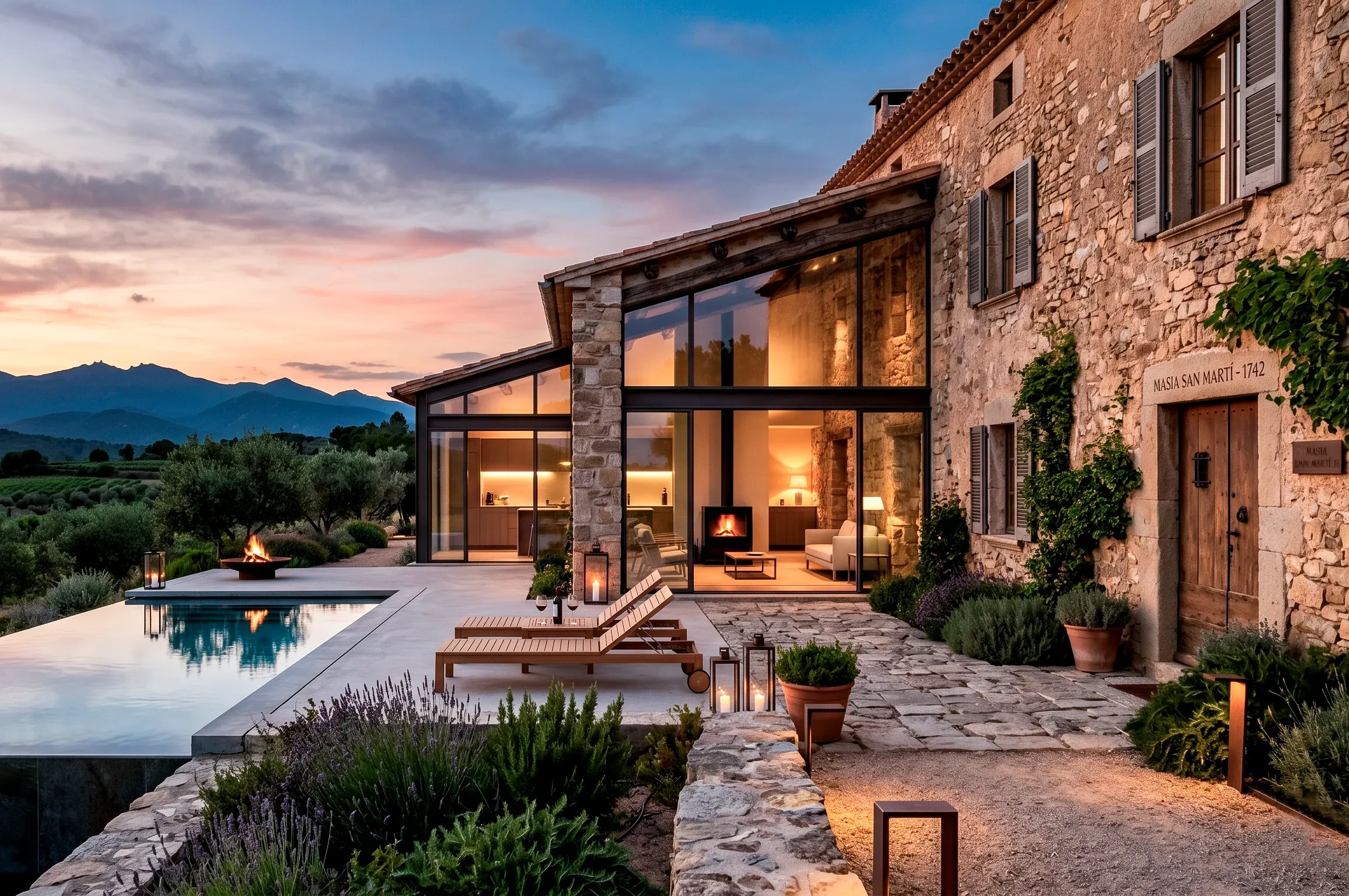
You walk past it a thousand times and don’t really see it. It’s made of stone, low to the ground, and it’s been there for three hundred years. Your grandparents saw it. Their grandparents did too.
And suddenly it’s become the most sought-after house on the market.
What’s changed? The masia — or us?
A gem that was always there
The masia hasn’t moved. It’s been in the same spot since it was built, stone by stone, by ordinary people.
What has moved is how we look at it.
For decades we looked the other way. Towards the villa, the semi-detached, the house with the pool. The masia was the past. The old. What you left behind when you got on in life.
Now the conversation has shifted, and we’re starting to see what was always there.
What a masia actually is
It isn’t a rural house. It isn’t a country estate. It isn’t a country house translated into Catalan.
The masia — the traditional Catalan farmhouse — is an agricultural production unit that built itself over centuries, generation by generation, adding whatever each moment needed. Dwelling, stable, storeroom, winery, threshing floor, barn. All under one roof, or attached to it.
A masia wasn’t designed. It accumulated.
Which is why no two are alike. And why, when one comes together well, it has a coherence that no architect-designed house achieves on the first attempt.
What modernity made us forget
For much of the twentieth century, the masia was a symbol of backwardness. Too dark. Too cold. Too rural.
The families who moved to the city closed them eagerly. Those who stayed divided them up, replaced the windows with aluminium frames, and painted the interiors white. Some just let them fall.
Meanwhile, magazines talked about villas, semi-detached houses, “modern family homes”. The masia dropped out of the conversation.
This wasn’t particular to here. The same thing happened to the caserío in the Basque Country, the borda in the Pyrenees, the barraca in the Valencian farmlands. Everything vernacular was sidelined at the same time, across all of Europe.
Why the masia is coming back now
Several things have changed at once.
The first is fatigue. People who have lived in new houses — with large windows and aluminium frames — have learnt what it costs to cool a glass box in August. They’ve learnt that underfloor heating doesn’t replace a metre-thick stone wall.
That the absence of texture in a house that only calls itself modern is paid for in discomfort and in the absence of any sense of belonging.
The second is craft. The original materials — local stone, timber, lime — have gone from being a mark of poverty to being genuinely difficult to source. Skills that few people still know how to apply.
The third goes deeper. After years of screens, plastics and identical surfaces, there is a renewed search for matter. For something with weight. For something that ages without falling apart.
A masia has weight. A masia ages well. A masia was invented by nobody, which is why it doesn’t look like anything else.
The decor trap: what restoring a masia is not
But there is a risk. Interest has arrived faster than understanding.
Some restorations keep the walls and fill the interior with a Scandinavian loft. A white box inside a stone shell. Every advantage the masia holds, wasted.
Others become obsessed with patina and end up making the house look like an Instagram set. A beautiful backdrop that doesn’t work as a home.
Restoring a masia is not a choice between preserving everything or stripping everything out. It’s about understanding why each element was where it was, and deciding case by case what still makes sense. The small openings aren’t a rustic quirk: they keep out the heat. The threshing floor isn’t decorative: it ventilated the house.
If you understand it, you restore it. If you don’t, you decorate it.
Our approach
At the studio, every masia starts with an unglamorous question: what made this building work?
That means reading the house before touching it. Identifying where the original hierarchy lies — the main hall, the agricultural outbuildings, the rooms added in the nineteenth century, the additions tacked on in the twentieth. And from that, deciding what is preserved, what is intervened with clear contemporary intent, and what disappears.
We work with stone, lime, timber and materials that age without being ashamed of it. And we let the house keep accumulating layers — because that’s always what it did.
The part that doesn’t show in photographs
What moves you most about a well-restored masia is invisible in photographs.
It’s the thickness of the wall when you press your hand against it. It’s the quiet inside rooms with low ceilings and small openings. It’s the smell of a stone house in summer, in the shade of a walnut tree.
That was there all along, waiting.
If you have a masia and want to understand what it’s worth before touching it — or if you’re thinking of buying one and need honest eyes on the real state of the building — write to us. It’s the conversation we enjoy starting the most.