Does Passivhaus Make Sense in the Mediterranean?
Why would you want a house designed to keep out the cold, if you live somewhere where heat is the problem? Is all that insulation, those extra centimetres of facade, all that airtightness really worth it? Could this all just be a northern fad that has no business here?
Let’s find out.
Where the Standard Comes From
Passivhaus was born in Darmstadt in 1991, developed by physicist Wolfgang Feist. Germany, continental climate, long winters. The idea was radical: build a home that could stay comfortable with almost no conventional heating system.
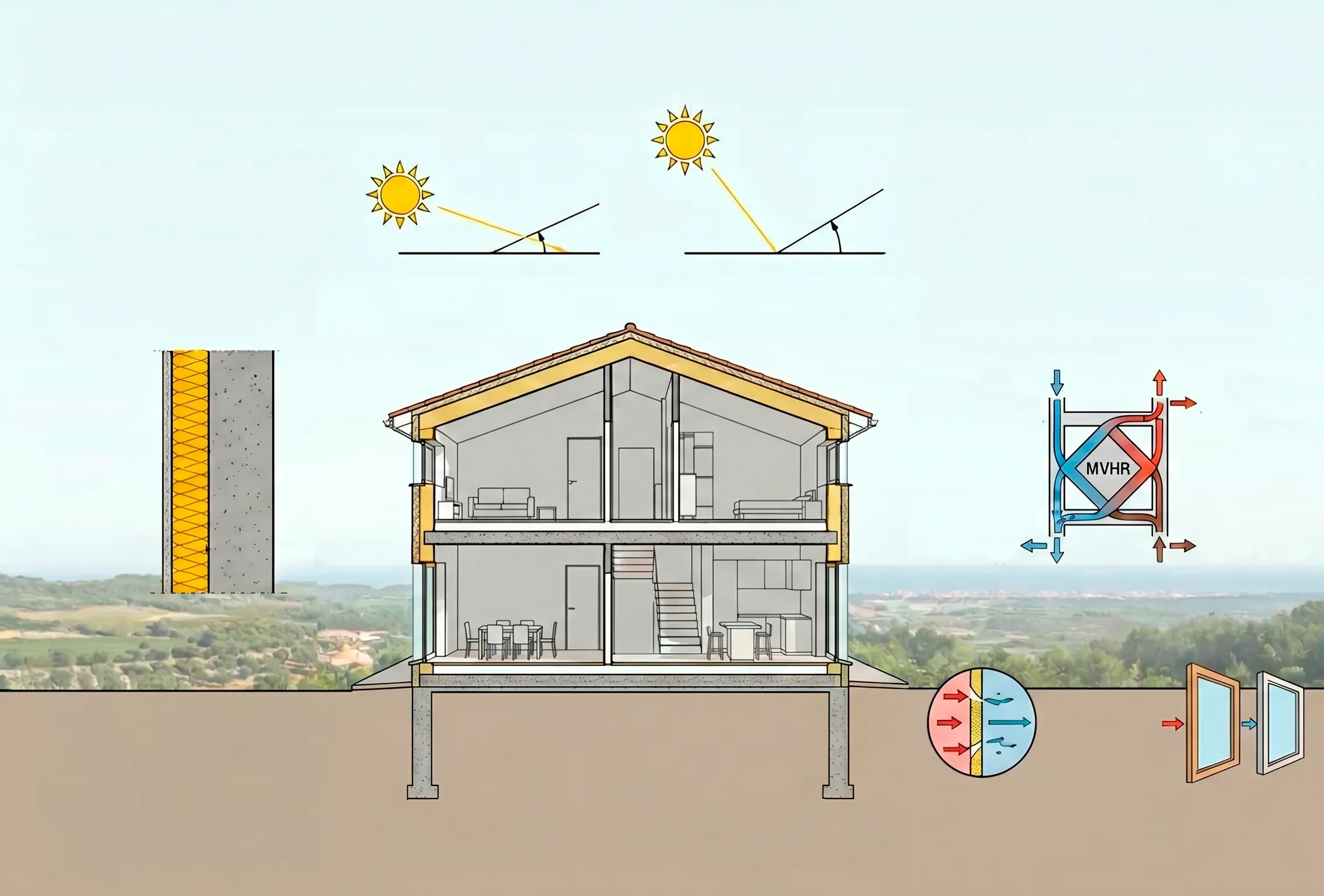
Five principles. Very high insulation. No thermal bridges. Airtightness. Mechanical ventilation with heat recovery. High-performance windows.
On paper, everything is aimed at not losing a single watt.
The Problem When You Bring It to Barcelona
Here you don’t spend three months running the heating. You spend three months escaping from the sun.
And the first logical reaction is: if I insulate the house so much, I’m going to trap the heat inside and it won’t be able to get out.
That reaction is logical. And it’s also wrong.
Good insulation doesn’t trap heat: it stops it from getting in.
A well-insulated facade works like a cool box. It works both ways. What does change — significantly — is everything you put around that cool box.
What Needs Adapting
The Mediterranean Passivhaus is not the German one with less insulation. It’s something else entirely.
Solar shading before insulation
In a cold climate, sunlight coming through the window is free energy. In a Mediterranean summer, it’s the enemy.
Overhangs calculated so that winter sun comes in and summer sun doesn’t. Exterior shutters, adjustable louvres, deciduous vegetation. Everything that traditional Catalan architecture already did without calling it Passivhaus.
Thermal mass
The Central European standard is often built light. Here, a good internal mass — a stone wall, an exposed concrete slab — acts as a thermal flywheel and smooths out temperature peaks.
Night-time ventilation
In the Mediterranean, nights cool down. A home designed to open when the temperature drops takes for free what during the day would cost money.
The Passivhaus Institut acknowledges this, which is why it introduced a specific criterion for warm climates: overheating frequency. No more than 10% of the year’s hours above 25°C indoors. A northern certificate, with a different test in the south.
The Trap of Copying the Manual
The mistake we see frequently is importing the German Passivhaus as-is. Heavy insulation, large south-facing windows with no shading, little shadow, and waiting for the miracle to happen.
It doesn’t. The house overheats.
The standard is a tool. The climate is the brief.
Our Approach
At Archtree we start with what Mediterranean architecture already knew before certifications existed: orient well, shade better, let the house breathe at night, and use materials with mass.
Then we apply the five Passivhaus principles on top of that. Not the other way round.
The result is homes that in August, with 35 degrees outside, don’t need air conditioning to stay at 25 inside. And that in January, with the fireplace off, hold at 21.
That’s what Passivhaus should mean here.
So, Does It Make Sense?
It makes complete sense. But only if you understand that the standard is a starting point, not a blueprint to copy.
If you’re thinking of building or renovating and want to know what all this means for your specific case, write to us. We’ll tell you in concrete terms.